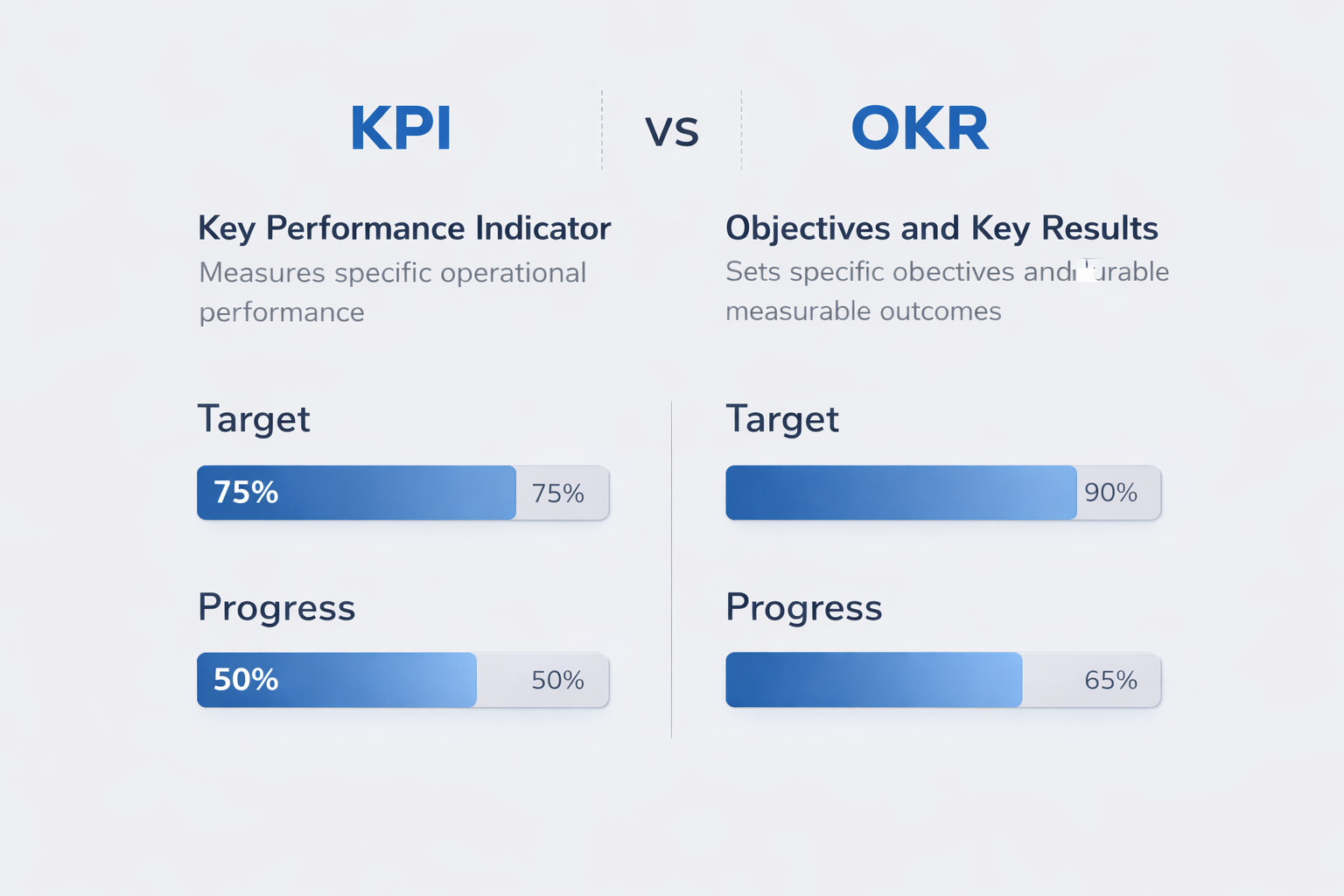
Teams often confuse KPIs and OKRs, then wonder why performance reporting feels messy. Here’s the clean separation:
- KPI (Key Performance Indicator): A metric that tracks performance and health.
- OKR (Objectives and Key Results): A goal-setting system that drives focused change.
KPI: “Are we healthy?”
KPIs are continuous signals—like a heart monitor.
Examples:
- Revenue growth rate
- CAC (Customer Acquisition Cost)
- Conversion rate
- Churn rate
- On-time delivery %
KPIs don’t automatically create progress. They create visibility.
OKR: “What are we changing?”
OKRs are designed to push improvement with clear outcomes.
Example OKR:
- Objective: Improve customer retention
- Key Results:
- Reduce churn from 6% → 4%
- Increase repeat purchase rate from 22% → 30%
- Raise NPS from 38 → 50
The correct way to connect them
- Use KPIs as your baseline and “always-on” dashboard.
- Use OKRs when you need focused progress on specific outcomes.
- Ensure Key Results are measurable and time-bound, not tasks.
Common mistakes to avoid
- Turning every KPI into an OKR (too many goals = no goals)
- Writing tasks as Key Results (“Launch feature X”) instead of outcomes
- Measuring what’s easy instead of what matters
Bottom line: KPIs keep you informed. OKRs help you transform. Use both—intentionally.