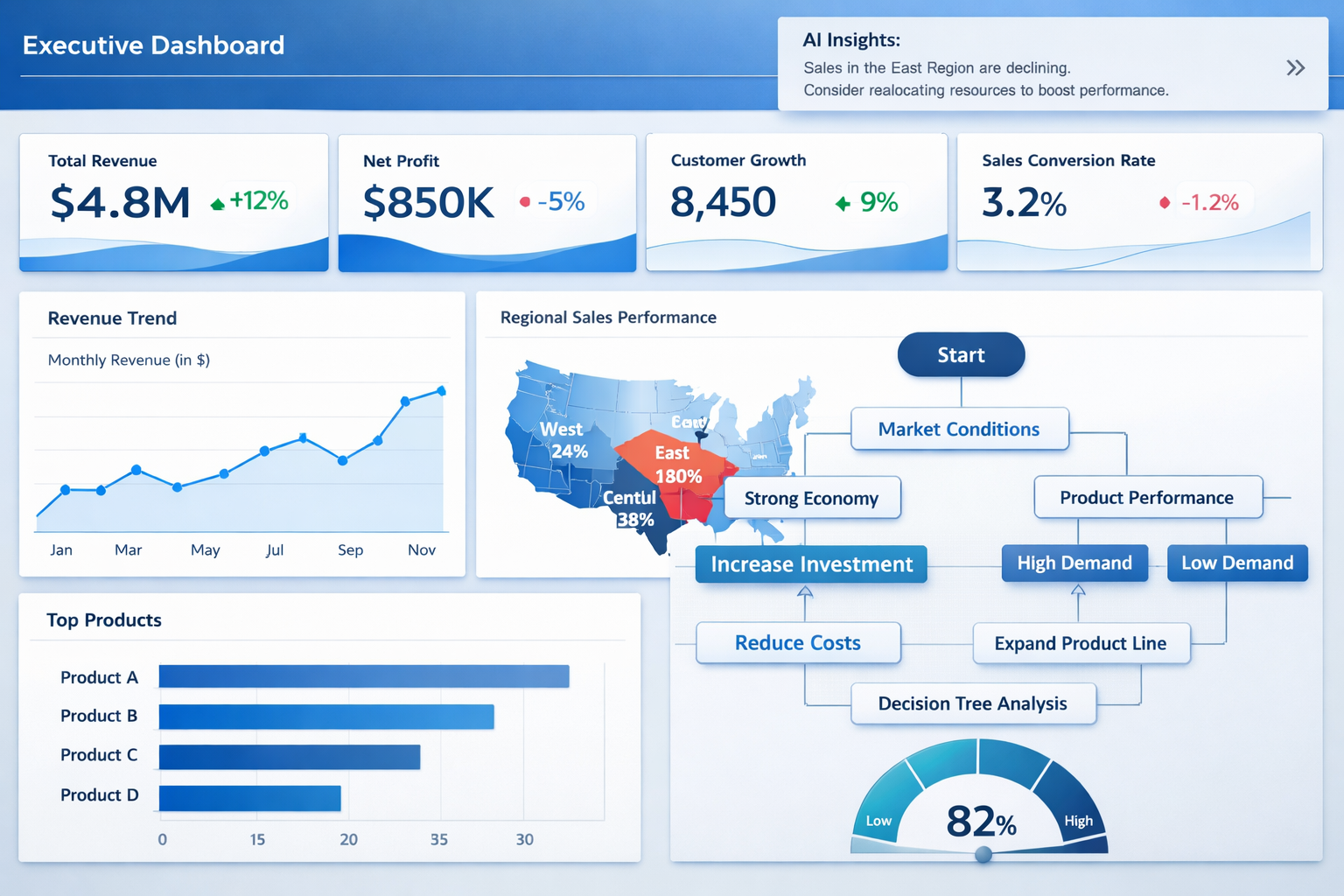
In fast-moving markets, the competitive edge is simple: make better decisions faster. Traditional business analytics helped organizations understand what happened (descriptive) and why it happened (diagnostic). With AI, we can also estimate what will happen (predictive) and recommend what to do next (prescriptive). When those pieces are connected to real-world processes, you get Decision Intelligence.
What is Decision Intelligence?
Decision Intelligence is the discipline of improving decisions by combining:
- Data pipelines (timely, trustworthy inputs)
- Analytics and AI models (predictions, optimization, scenario simulation)
- Decision workflows (clear actions, approvals, accountability)
It’s not just “build a model.” It’s “build a decision system.”
What it looks like in real businesses
- Retail: Demand forecasting isn’t enough. Decision Intelligence answers: How much inventory should we keep, where, and when, to maximize margin while minimizing stock-outs?
- Banking: Instead of only predicting default risk, DI asks: Which offer increases approval rates and revenue without raising portfolio risk?
- Operations: Beyond predicting machine failure, DI recommends: Which maintenance plan reduces downtime with the lowest cost?
How to start (without boiling the ocean)
- Choose 2–3 high-impact decisions (churn reduction, pricing, forecasting, fraud, logistics).
- Run a data readiness audit (quality, missing values, bias, latency).
- Build a baseline model + simple dashboard first.
- Add human-in-the-loop review so decision makers trust and refine outcomes.
- Track value with measurable outcomes (cost saved, revenue gained, time reduced).
Bottom line: AI creates value when insights reliably become action. Decision Intelligence is the bridge that makes that happen.